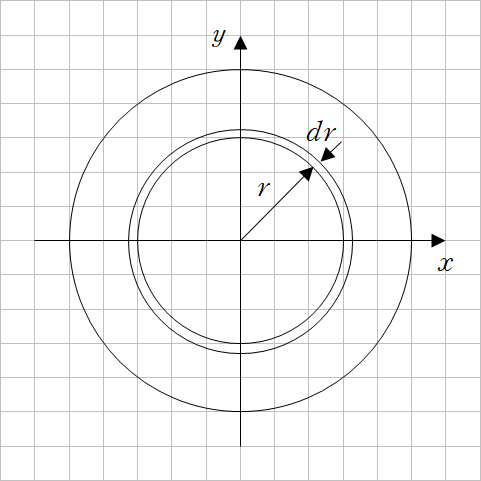
원의 면적을 구하기 위해 반지름이  인 원을 그리고 미소반지름
  만큼 더 큰 원을 그렸을 때 그 사이의 미소면적을
  라고 하면 다음과 같이 쓸 수 있다.
![\[ dS = 2 \pi r dr \]](https://saegil-lab.kr/wp-content/ql-cache/quicklatex.com-4d3bd0acb60d828e89ad65047acd0f8a_l3.png "Rendered by QuickLaTeX.com")
전체 면적을 계산하기 위해 을 0에서 까지 적분하면 다음과 같이 원의 면적을 계산할 수 있다.
![\[ S = \int_0^r dS = \int_0^r 2\pi r dr = 2 \pi \left [ \frac{1}{2} r^2 \right ]_0^r = \pi r^2 \]](https://saegil-lab.kr/wp-content/ql-cache/quicklatex.com-ffa8c676a950e13f0b37b85b72a0ffe5_l3.png "Rendered by QuickLaTeX.com")
 증명 1
증명 1원의 면적을 구하기 위해 반지름이 인 원을 그리고 미소반지름 만큼 더 큰 원을 그렸을 때 그 사이의 미소면적을 라고 하면 다음과 같이 쓸 수 있다.
전체 면적을 계산하기 위해 을 0에서 까지 적분하면 다음과 같이 원의 면적을 계산할 수 있다.
 증명
증명 ![\[\lim_{\theta \rightarrow 0} \frac{\sin\theta}{\theta} = 1\]](https://saegil-lab.kr/wp-content/ql-cache/quicklatex.com-ad4494612cfc0468bffbd2b2436342ac_l3.png "Rendered by QuickLaTeX.com")
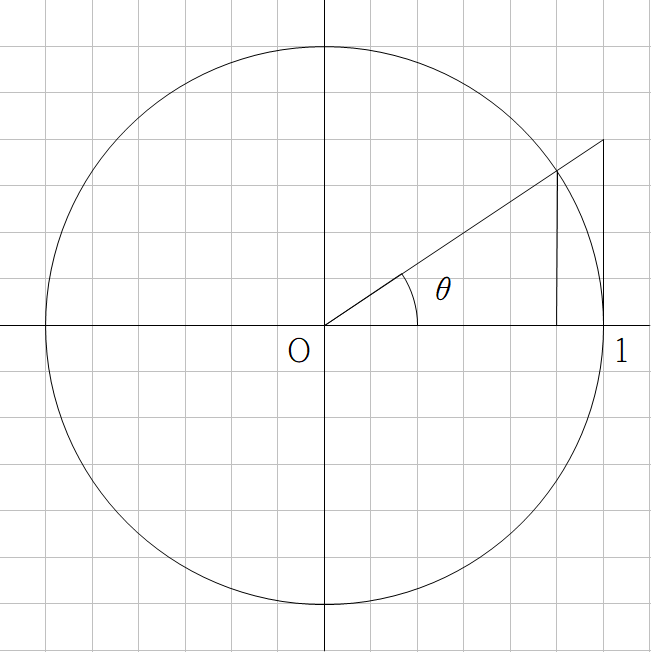
위와 같이 반지름이 1인 원을 그리고 각도  를 잡으면 작은 삼각형의 높이
  , 호의 길이 , 큰 삼각형의 높이
  사이에는 다음과 같은 관계가 성립한다.
![\[\sin\theta < \theta < \tan \theta \]](https://saegil-lab.kr/wp-content/ql-cache/quicklatex.com-9dc6afd835515b4b6fabe74efdfec082_l3.png "Rendered by QuickLaTeX.com")
 이고, 각 변을 로 나누면 다음과 같다.
![\[ 1 < \frac{\theta}{\sin \theta} < \frac{1}{\cos\theta} \]](https://saegil-lab.kr/wp-content/ql-cache/quicklatex.com-33fc289d84ebefc960b1e4aee1c12f46_l3.png "Rendered by QuickLaTeX.com")
각 항의 역수를 구하면 부등호의 방향이 바뀌며 다음과 같은 관계가 성립한다.
![\[ 1 > \frac{\sin\theta}{\theta} > \cos \theta \]](https://saegil-lab.kr/wp-content/ql-cache/quicklatex.com-2dce5c9f7671eb3b15f1cee4d7d82b67_l3.png "Rendered by QuickLaTeX.com")
 일 때
일 때  이므로 샌드위치 정리에 의해
![\[ \lim_{\theta \rightarrow 0} \frac{\sin\theta}{\theta} = 1 \]](https://saegil-lab.kr/wp-content/ql-cache/quicklatex.com-d8ba4b6a6bcd50e3d32da12152190fb6_l3.png "Rendered by QuickLaTeX.com")
 연습용 2
연습용 2
At first, we sample  in the
  ( is odd) equidistant points around
  :
:
![\[f_k = f(x_k), \:x_k = x^* + kh, \:k=-\frac{N-1}{2}, \dots, \frac{N-1}{2}\]](https://saegil-lab.kr/wp-content/ql-cache/quicklatex.com-2f589eb7ba021387b32b97e2b593cfe6_l3.png "Rendered by QuickLaTeX.com")
where  is some step.
Then we interpolate points  by polynomial
(1) 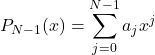
It’s cofficients  are found as a solution of system of linear equations:
(2) 
Here are references to existing equations: (1), (2).
Here is reference to non-existing equation (??).
연습용
 를 변수로 함수
운동에너지 
퍼텐셜에너지 
![\[ E=E_k + E_p = \frac{1}{2} mv^2 +mgh \]](https://saegil-lab.kr/wp-content/ql-cache/quicklatex.com-24f60410366930c34e86c64315acc997_l3.png "Rendered by QuickLaTeX.com")
![\[I = \int_{0}^{\infty} {e^{-x^2}dx}\]](https://saegil-lab.kr/wp-content/ql-cache/quicklatex.com-739c9dca79056f909dfa4de3eff86892_l3.png "Rendered by QuickLaTeX.com")
![\[E = mc^2\]](https://saegil-lab.kr/wp-content/ql-cache/quicklatex.com-8a67c91ea74aaf9148061bc5dee9e72b_l3.png "Rendered by QuickLaTeX.com")
![\[m = \frac{m_0}{\sqrt{1-{v^2}/{c^2}}}\]](https://saegil-lab.kr/wp-content/ql-cache/quicklatex.com-491e449512cba465d7e5d7c001332159_l3.png "Rendered by QuickLaTeX.com")
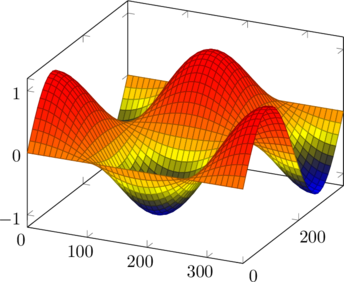
다음 그림은  의 값을 0도에서 360까지 3차원 그래프로 표현한 tikZ 패키지를 이용한 그림입니다.