 의 계산(Leibnitz공식, Machin공식)
- 이항정리
 일 때
일 때
![\[(1+x)^n = 1 + nx + \frac{n(n-1)}{2!}x^2 + \frac{n(n-1)(n-2)}{3!}x^3 + \cdots\]](https://saegil-lab.kr/wp-content/ql-cache/quicklatex.com-388d5ce4f3d2b7756567484f557b1e8d_l3.png "Rendered by QuickLaTeX.com")
- Leibnitz(라이프니츠) 공식
 을 이항정리로 전개시키면 다음과 같은 식을 얻을 수 있다.
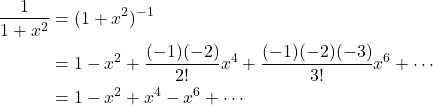
위 식을  에서
에서  까지 적분하면 다음과 같다.

위의 식에서 오른쪽 적분은 다음과 같이 구할 수 있다.

왼쪽 적분을 하기 위해  라고 하면
라고 하면  ,
,  이므로
이므로
![\[ \int \frac{1}{1+x^2} dx = \theta + {\rm C} = \arctan x + {\rm C}\]](https://saegil-lab.kr/wp-content/ql-cache/quicklatex.com-d83ce3e7d783111d4a6702b6e773eb59_l3.png "Rendered by QuickLaTeX.com")
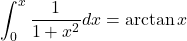
![\[ \arctan x =x - \frac{1}{3}x^3 + \frac{1}{5}x^5 - \frac{1}{7}x^7 + \cdots \]](https://saegil-lab.kr/wp-content/ql-cache/quicklatex.com-f24a44930c7582f9c6c4f9110b9f83fd_l3.png "Rendered by QuickLaTeX.com")
위의 식에서 의 값을 음(-)의 방향에서 1로 가까이 보내면(즉,  ) 다음 식을 얻을 수 있다.
![\[\frac{\pi}{4} = 1 - \frac{1}{3} + \frac{1}{5} - \frac{1}{7} + \cdots \]](https://saegil-lab.kr/wp-content/ql-cache/quicklatex.com-1329113079b6d6f81af1e68232b9f77d_l3.png "Rendered by QuickLaTeX.com")
- Machin(마친) 공식
 라고 하면
라고 하면
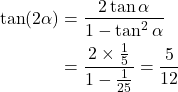
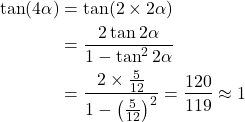
따라서  인 것을 알 수 있다.
 라고 하면
라고 하면
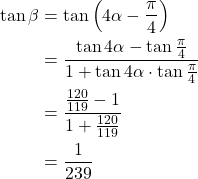
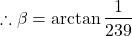
 이므로
이므로
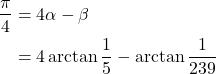
![\[ \therefore \frac{\pi}{4} = 4 \arctan\frac{1}{5} - \arctan\frac{1}{239} \]](https://saegil-lab.kr/wp-content/ql-cache/quicklatex.com-0f6c88e50493da7197838fcef7fe927b_l3.png "Rendered by QuickLaTeX.com")
 증명 3
증명 3
 인 원을 12등분하고 내부에 12개의 삼각형을 그린 그림이다. 이 경우 원의 중심에서 삼각형의 중심각은
  한 변의 길이가 각각
  은 다음과 같다.
![\[ S_1 = \frac{1}{2}r^2 \sin\left( \frac{2\pi}{12} \right)\]](https://saegil-lab.kr/wp-content/ql-cache/quicklatex.com-00b5afd737128e14a54b730a7c26d355_l3.png "Rendered by QuickLaTeX.com")
 각형으로 근사시켰을 때
 ![\[ S_1 = \frac{1}{2} r^2 \sin \left( \frac{2\pi}{n}\right) \]](https://saegil-lab.kr/wp-content/ql-cache/quicklatex.com-27a02ed663f5ec7801b8708981c81c6d_l3.png "Rendered by QuickLaTeX.com")
 이라고 하면 다음과 같이 쓸 수 있다.
![\[ S_n = n \cdot \frac{1}{2} r^2 \sin\left( \frac{2\pi}{n} \right) \]](https://saegil-lab.kr/wp-content/ql-cache/quicklatex.com-e90f7dee7cf17c54a5b22424fd159973_l3.png "Rendered by QuickLaTeX.com")
 로 근사시킬 수 있다.
![\[ S= \lim_{n \rightarrow \infty} S_n = \frac{1}{2} r^2 \lim_{n \rightarrow \infty} n \sin \left( \frac{2\pi}{n}\right)\]](https://saegil-lab.kr/wp-content/ql-cache/quicklatex.com-5b27274531eabfd87059c684ae242309_l3.png "Rendered by QuickLaTeX.com")
 라고 하면
라고 하면  가 되고
가 되고  일 때
일 때  이가 되므로 원의 면적은 다음과 같이 구할 수 있다.
![\[ S = \frac{1}{2} r^2 \lim_{\theta \rightarrow 0} \frac{2 \pi}{\theta} \sin \theta = \pi r^2 \lim_{\theta \rightarrow 0} \frac{\sin \theta}{\theta} \]](https://saegil-lab.kr/wp-content/ql-cache/quicklatex.com-6e3387c018b65311cf9b0be8ffd27b58_l3.png "Rendered by QuickLaTeX.com")

![\[ S= \pi r^2\]](https://saegil-lab.kr/wp-content/ql-cache/quicklatex.com-8823c1b6735702b8532d920eea4aba03_l3.png "Rendered by QuickLaTeX.com")

 이므로
이므로  값은 다음과 같이 주어진다.
![\[ y=\sqrt{r^2 - x^2} \]](https://saegil-lab.kr/wp-content/ql-cache/quicklatex.com-096228ab1b43aa73331f8dc92496f6eb_l3.png "Rendered by QuickLaTeX.com")
 은 다음과 같이 쓸 수 있다.
![\[ dS_1 = y dx = \sqrt{r^2-x^2} dx \]](https://saegil-lab.kr/wp-content/ql-cache/quicklatex.com-eac257188aaa63e35e30b03bdf7fe047_l3.png "Rendered by QuickLaTeX.com")
![\[ \therefore S_1 = \int_0^r \sqrt{r^2 - x^2} dx \]](https://saegil-lab.kr/wp-content/ql-cache/quicklatex.com-30282a7d7b72eda58a5cf5a8cec95d8d_l3.png "Rendered by QuickLaTeX.com")
 라고 하면
라고 하면  일 때
일 때  ,
,  일 때
일 때  이 되는 것을 알 수 있고 다음과 같은 관계를 찾을 수 있다.
![\[ dx = -r \sin \theta d\theta \]](https://saegil-lab.kr/wp-content/ql-cache/quicklatex.com-3720c822c3316c2411292cb8d1153531_l3.png "Rendered by QuickLaTeX.com")
![\[ \sqrt{r^2 - x^2} = r \sin \theta \]](https://saegil-lab.kr/wp-content/ql-cache/quicklatex.com-c5c1ccccb46c3cf4d52c64f0fe13edbe_l3.png "Rendered by QuickLaTeX.com")
![\[ \therefore S_1 = \int_{\frac{\pi}{2}}^{0} r \sin \theta (- r \sin \theta) d\theta = \int_0^{\frac{\pi}{2}} r^2 \sin^2\theta d\theta\]](https://saegil-lab.kr/wp-content/ql-cache/quicklatex.com-dd7973109f64ef0e38fa34d80d9532d7_l3.png "Rendered by QuickLaTeX.com")
 라는 관계가 성립하므로
 ![\[ S_1 = r^2\int_0^{\frac{\pi}{2}} \frac{1 - \cos 2\theta}{2} d\theta = \frac{r^2}{2} \left[ \theta - \frac{1}{2} \sin 2 \theta \right] _0^{\frac{\pi}{2}} = \frac{1}{4}\pi r^2 \]](https://saegil-lab.kr/wp-content/ql-cache/quicklatex.com-30582f8620fc9dcb0397b9041d83a23f_l3.png "Rendered by QuickLaTeX.com")
![\[\therefore S = 4S' = 4 \cdot \frac{1}{4} \pi r^2 = \pi r^2 \]](https://saegil-lab.kr/wp-content/ql-cache/quicklatex.com-2a8d1f646190a442b953a1e4ab7c2617_l3.png "Rendered by QuickLaTeX.com")
![\[ \]](https://saegil-lab.kr/wp-content/ql-cache/quicklatex.com-47b12f571f217a5643b6c7a48a9a870f_l3.png "Rendered by QuickLaTeX.com")
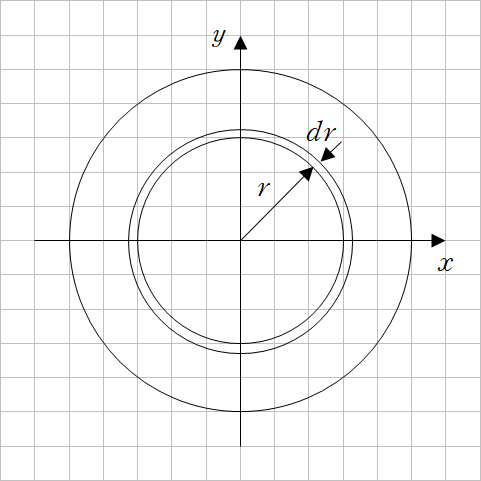
 만큼 더 큰 원을 그렸을 때 그 사이의 미소면적을
  라고 하면 다음과 같이 쓸 수 있다.
![\[ dS = 2 \pi r dr \]](https://saegil-lab.kr/wp-content/ql-cache/quicklatex.com-4d3bd0acb60d828e89ad65047acd0f8a_l3.png "Rendered by QuickLaTeX.com")
![\[ S = \int_0^r dS = \int_0^r 2\pi r dr = 2 \pi \left [ \frac{1}{2} r^2 \right ]_0^r = \pi r^2 \]](https://saegil-lab.kr/wp-content/ql-cache/quicklatex.com-ffa8c676a950e13f0b37b85b72a0ffe5_l3.png "Rendered by QuickLaTeX.com")